

Free Daily Headlines :

  • COVID-19
  • Money
  • Politics
  • Education
  • Health
  • Justice
  • More
    • Environment
    • Economic Development
    • Gaming
    • Investigations
    • Social Services
    • TRANSPORTATION
OPINION
  • CT Viewpoints
  • CT Artpoints
DONATE
Reflecting Connecticut’s Reality.
    COVID-19
    Money
    Politics
    Education
    Health
    Justice
    More
    Environment
    Economic Development
    Gaming
    Investigations
    Social Services
    TRANSPORTATION
CT Viewpoints CT Artpoints

LET�S GET SOCIAL

Show your love for great stories and out standing journalism

School funding falls far short of leveling the playing field for CT students

  • Education
  • by Jacqueline Rabe Thomas
  • September 17, 2020
  • View as "Clean Read" "Exit Clean Read"

www.CtMirror.org

Smalley Academy in New Britain, where the overwhelming majority of students are Latino and Black students. The district is also one of the most underfunded districts in the state and lowest-achieving.

The state’s school funding formula is failing to bridge the divide between what rich and poor towns can afford to spend on educating their students. To close these yawning disparities, the state needs to spend anywhere from an additional $338 million to $1.7 billion more a year.

These are the conclusions of a trio of analyses on how the state funds its schools. Those studies – by the New England Public Policy Center, the School and State Finance Project, and the Rutgers Graduate School of Education – were provided to the CT Mirror this week.

The Federal Reserve Bank of Boston’s New England Public Policy Center pegged the annual cost of closing this gap at between $940 million and $1.7 billion, depending on how many additional students are helped by the additional funding.

“There are large disparities in spending across school districts. Many districts’ spending is inadequate to achieve the statewide average student performance level, given their higher costs. Ensuring that every district is financially equipped to reach that performance target would require a significant increase in school spending,” authors Bo Zhao and Nicholas Chiumenti write. “Statewide 51.5% of public school students were enrolled in districts where spending was inadequate for achieving this target.”

For example, in Hartford, where the overwhelming majority of students come from low-income families and are Black or Hispanic, the policy center finds the district would need to spend an additional $7,780 per student – a 47% boost – to keep up with the state spending and performance averages. The shortfall is so glaring because students who live in poverty or in a single-parent household typically cost more to educate at the same level as their better-off peers, the authors conclude. Meanwhile, wealthy suburban districts with minimal diversity are spending well over what is necessary.

While the Federal Reserve’s analysis is based on school spending and students test outcomes between 2009 and 2013, research based on more recent spending numbers shows these disparities fester.  The authors of the report said that this was the most recent time frame they could use because the state transitioned to a new test in 2014, but regardless said spending has remained relatively stable since then.

An analysis by The School and State Finance Project found that the state’s school-funding formula is $338 million short of leveling the playing field between the Black and Hispanic students attending segregated traditional public schools and the students attending suburban schools with few minorities. Charter schools, which are also overwhelmingly segregated, would need $52 million more to bridge the gap. There is no disparity in magnet schools, the bulk of which were opened in the wake of a landmark school desegregation case.

“These startling funding gaps show Connecticut’s school districts suffer not just from vast racial segregation but from segregation of opportunities. These funding gaps are more than just numbers in a report. Each gap represents the financial resources and educational opportunities that continue to be inaccessible for many of Connecticut’s students of color as a result of inequitable education funding, a property tax system in dire need of reform, and longstanding segregation across our state’s cities, towns, and school districts,” said Katie Roy, the executive director of the School and State Finance Project.
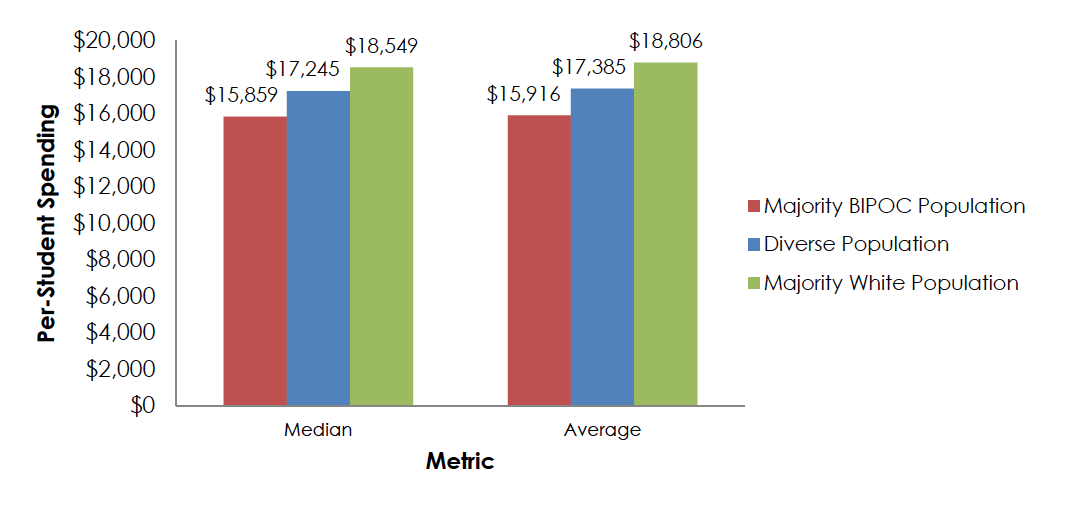
Majority BIPOC Population: Districts with a Black, Indigenous and People of Color student population that is greater than 75% of the district’s enrollment; Majority White Population: Districts with a White student population that is greater than 75%; and Diverse Population: Districts with a BIPOC student population between 25% and 75%

The legislature and governor have pumped slightly more aid each year into the state’s primary K-12 grant – the Education Equalization Grant – and Connecticut is slated to spend an additional $39 million a year for each of the next seven years, unless the state’s potentially rocky fiscal future changes that.

But, even this funding increase won’t change much, the study found. Even if the state were to fully fund the grant this year, the state’s most segregated districts would still need $151 million more to bridge the divide.

“There just isn’t enough state aid available. It’s like trying to fix a broken pipe with a roll of scotch tape,” said Roy.

A philosophical tug-of-war over how Connecticut should fund its public schools has been debated at the state Capitol for decades. On one side you have those that say the state should hire a team of experts to determine how much it will actually cost to provide students with an adequate education. With that cost estimate, the state should base its school-funding formula around. On the other side, you have those who say costing-out education is an impossible task and state spending should not be beholden to such a study.

What Connecticut has instead is a funding method based largely on how much the state can spend. The state’s formula arbitrarily starts with every student receiving roughly $11,000 a year, and then is adjusted up or down based on specific factors, like the wealth of the student’s school district or whether the student comes from a low-income family.

There seems to be little appetite to change this method anytime soon. The state’s current funding formula is somewhat on autopilot, the result of a bipartisan budget passed as the General Assembly waited in 2017 for the Connecticut Supreme Court to decide whether the state was adequately funding its schools.

The Supreme Court ultimately decided it was, and legislators seem loathe to handle the hot potato of school funding reform.

On the national stage, Connecticut’s segregation stands out, largely the result of the housing policies that barred working class, low-income families from moving into communities like Weston and Westport.

This isolation – and state and federal inaction to equitably fund schools – has a significant impact on Connecticut’s Latinx students, said Bruce Baker, a professor at Rutgers Graduate School of Education.

His research has found that Connecticut has the strongest spending disparities in the U.S and individual school districts here are among the most disadvantaged financially in the country. New Britain comes in second place, Bridgeport third and Waterbury 17th for their amount of revenue and poverty compared to neighboring districts.
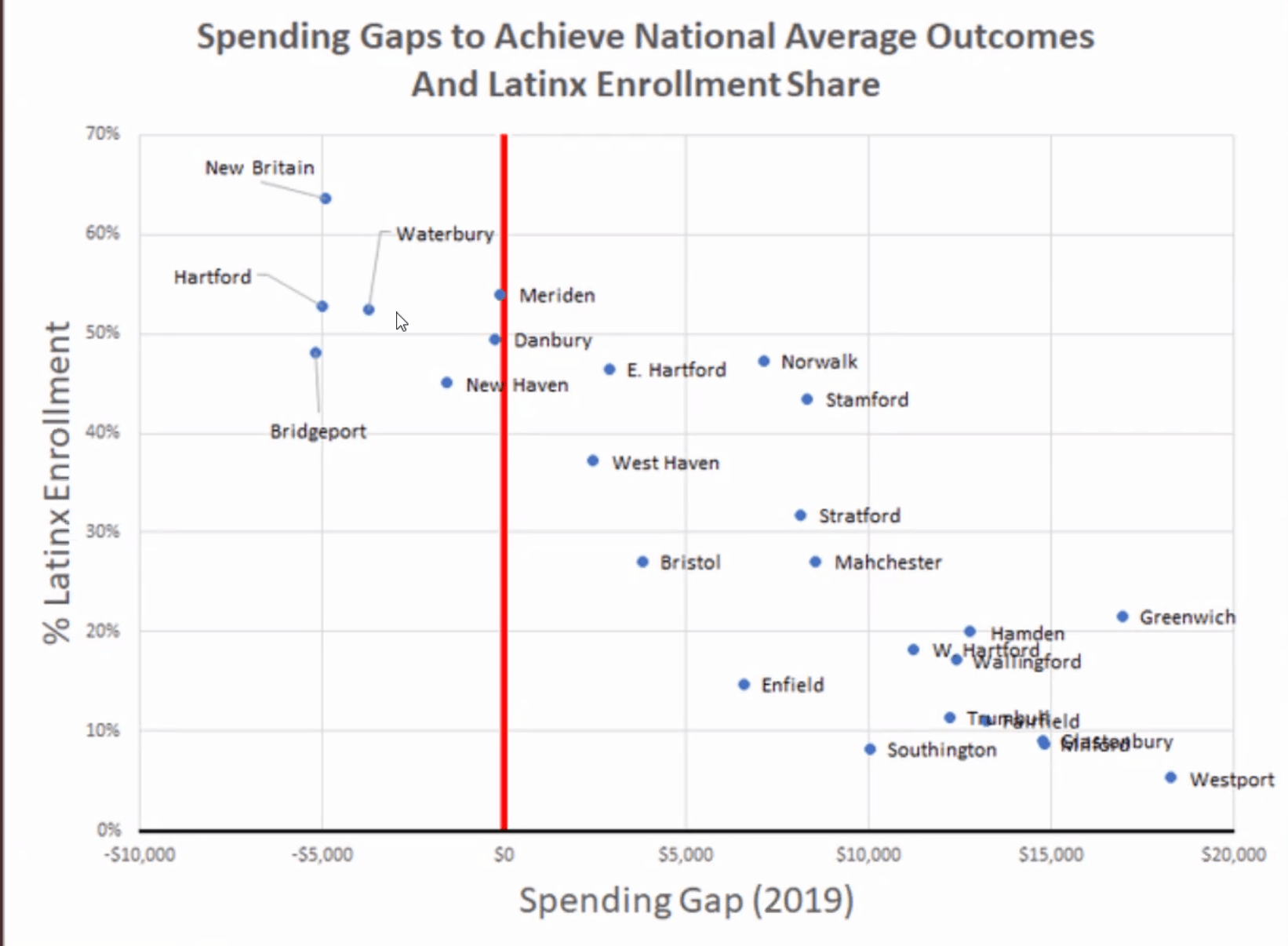
His research – conducted with researchers at The University of Connecticut – also shows, however, that Black student populations have fared somewhat better because of the desegregation remedies that drove funding to open magnet schools in the predominantly Black districts of Hartford and New Haven.

An analysis Baker provided Wednesday to the CT Mirror shows it would cost an additional $374 million to close the spending gap for Connecticut’s segregated school districts and spend enough to provide students the opportunity to reach national averages for outcomes.

“The gaps for places like Bridgeport, Waterbury, and New Britain are just huge,” he said of the spending levels. “We know that it costs more to achieve the same outcomes in districts that are higher in poverty, more racially isolated, have more English learners. … It might cost 75% more to achieve national average outcomes.”

Sign up for CT Mirror's free daily news summary.

Free to Read. Not Free to Produce.

The Connecticut Mirror is a nonprofit newsroom. 90% of our revenue comes from people like you. If you value our reporting please consider making a donation. You'll enjoy reading CT Mirror even more knowing you helped make it happen.

YES, I'LL DONATE TODAY

ABOUT THE AUTHOR

Jacqueline Rabe Thomas is CT Mirror’s Education and Housing Reporter and an original member of the CT Mirror staff. She has won first-place awards for investigative reporting from state, New England, and national organizations. Before joining CT Mirror in late 2009, Jacqueline was a reporter, online editor and website developer for The Washington Post Co.’s Maryland newspaper chains. She has also worked for Congressional Quarterly and the Toledo Free Press. Jacqueline received an undergraduate degree in journalism from Bowling Green State University and a master’s in public policy from Trinity College.

SEE WHAT READERS SAID

RELATED STORIES
Murphy says Dalio partnership showed the risk of trading influence for philanthropy
by Keith M. Phaneuf

"No billionaire should have more say than my poorest constituent," Murphy says.

In New Haven schools, nearly a quarter of students aren’t fully participating
by Adria Watson

Nearly a quarter of New Haven students aren't fully attending remote learning.

Has Connecticut safely reopened its schools? The state and its teachers disagree
by Adria Watson

A coalition of teacher's unions said there are “red flags" contradicting CT's assertion that school reopenings have been a success.

The state has left school closing and reopening decisions to districts. That could be a problem.
by Adria Watson

Advocates worry the state's hands-off approach could harm Connecticut's most vulnerable students, who struggle to learn remotely.

With majority of schools online, state begins delivering computers and Wi-Fi to needy students
by Jacqueline Rabe Thomas

The state announced Tuesday that 20,000 of the 81,000 students who need a laptop for classes will receive one soon.

Support Our Work

Show your love for great stories and outstanding journalism.

$
Select One
  • Monthly
  • Yearly
  • Once
Artpoint painter
CT ViewpointsCT Artpoints
Opinion To overcome racism, students need a better understanding of our history, Declaration of Independence and Constitution
by Susan Harris

What is it that unites us as citizens of a republic where a former slave becomes a great orator for the abolition effort and insists upon education as the means for keeping all men and women free?

Opinion Legal marijuana poses an unnecessary public health risk
by William Butka

Congress has called for a vote on H.R. 3884, which involves the legalization of Marijuana.  I have written to all of Connecticut’s Congressional representatives, strongly urging them to reject this legislation.  I cannot believe that Congress would consider this legislation, especially at a time when our country is burning and there is destruction and violence nationwide.

Opinion Left powerless again, we need an ongoing plan to bury power lines
by Toni Boucher

The cost of delivering electricity is exorbitant and increasingly unreliable in Connecticut. On August 4 Tropical Storm Isaias arrived here, leaving over 800,000 customers powerless for ten days. Utilities’ failure to respond, poor planning and lack of information to customers and municipalities, and crews standing idle without direction, enraged ratepayers.

Opinion Let them play football!
by Kim Healy

Connecticut legislators need to intervene and ensure that our state’s high school football players are permitted to play this season with full teams. The Connecticut Interscholastic Athletic Conference (CIAC) announced that it would follow the state’s Department of Public Health order, which would prevent these young athletes from playing this season. This is not fair, nor reasonable, and it is parents who should decide what is best for their children, not the state.

Artwork Shea
by Anthony Valentine

Shea is a story about race and social inequalities that plague America. It is a narrative that prompts the question, “Do you know what it’s like to wake up in new skin?” Anthony Valentine lives in Bloomfield

Artwork The Declaration of Human Rights
by Andres Chaparro

Through my artwork I strive to create an example of ideas that reflect my desire to raise social consciousness, and cultural awareness. Jazz music is the catalyst to all my work, and plays a major influence in each piece of work.”

Artwork ‘A thing of beauty. Destroy it forever’
by Richard DiCarlo | Derby

During times like these it’s often fun to revisit something familiar and approach things with a different slant. I have been taking some Pop culture and Art masterpieces and applying the vintage 1960’s and 70’s classic figures (Fisher Price, little people) to the make an amusing pieces. Here is my homage to Fisher -Price, Yellow […]

Artwork Shadows on the farm
by Ellen Pliskin

About the art: This was a local landmark on Marion Road in Cheshire. I have painted this old cider mill and farm over many years and felt it was a part of Connecticut’s history. Ellen Pliskin lives in Cheshire.

Twitter Feed
A Twitter List by CTMirror

Engage

  • Reflections Tickets & Sponsorships
  • Events
  • Donate
  • Newsletter Sign-Up
  • Submit to Viewpoints
  • Submit to ArtPoints
  • Economic Indicator Dashboard
  • Speaking Engagements
  • Commenting Guidelines
  • Legal Notices
  • Contact Us

About

  • About CT Mirror
  • Board
  • Staff
  • Sponsors and Funders
  • Donors
  • Friends of CT Mirror
  • History
  • Financial
  • Policies
  • Strategic Plan

Opportunity

  • Advertising and Sponsorship
  • Speaking Engagements
  • Use of Photography
  • Work for Us

Go Deeper

  • Steady Habits Podcast
  • Economic Indicator Dashboard
  • Five Things

The Connecticut News Project, Inc. 1049 Asylum Avenue, Hartford, CT 06105. Phone: 860-218-6380

© Copyright 2020, The Connecticut News Project. All Rights Reserved. Website by Web Publisher PRO