



A last-minute boost in state funding won’t stave off a looming fiscal crisis for Connecticut’s public colleges and universities, the Board of Regents for Higher Education reported Thursday.
Regents: Extra state funds not a cure-all for a system in crisis

Posted inCT Viewpoints
SEBAC members: Re-open your agreement before an ‘event’

We — as in everyone who lives and works in our state — have a problem. We will never, ever, be able to generate enough revenue to cover the cash demanded by our unfunded union liabilities. It doesn’t make a difference how we got here. Pointing fingers and demonizing each other does nothing. It’s our fault; we are here and it is up to us to fix it.

Posted inCT Viewpoints
Let’s build a bridge to a reliable, efficient, affordable energy future
Connecticut has many assets that can help us grow our economy, create jobs, and address our serious fiscal challenges. But one significant competitive hurdle that must be overcome is our distinction as the most costly energy state in the country. New England has long been at an economic disadvantage for energy costs, largely due to the distance from where traditional energy fuels were harvested and processed. This meant we paid the costs associated with constructing and maintaining several thousands of miles of pipeline infrastructure and other costs associated with transporting fuels to our region.

Posted inPolitics
Malloy delivers a funny farewell in midnight address

With a self-deprecating humor, Gov. Dannel P. Malloy addressed a joint convention of the General Assembly for the last time early Thursday, celebrating accomplishments of the past eight years and wryly acknowledging that he will leave politics as one of the least popular governors in the U.S.

Posted inPolitics
As clock strikes 12, minimum wage among legislative casualties
The General Assembly’s regular session ended Wednesday night without the Democratic legislative leadership delivering on a promised progressive agenda of a livable wage, paid family medical leave and an overhaul of state laws on sexual harassment in the workplace.

Posted inMoney
Legislature overwhelmingly enacts bipartisan CT budget
The legislature overwhelmingly approved a new state budget shortly before their midnight deadline Wednesday that restores aid for towns; reverses health care cuts for the elderly, poor and disabled; and defers a transportation crisis — at least for another year.
Posted inNews
Leaders unveil bipartisan budget deal eight hours before deadline
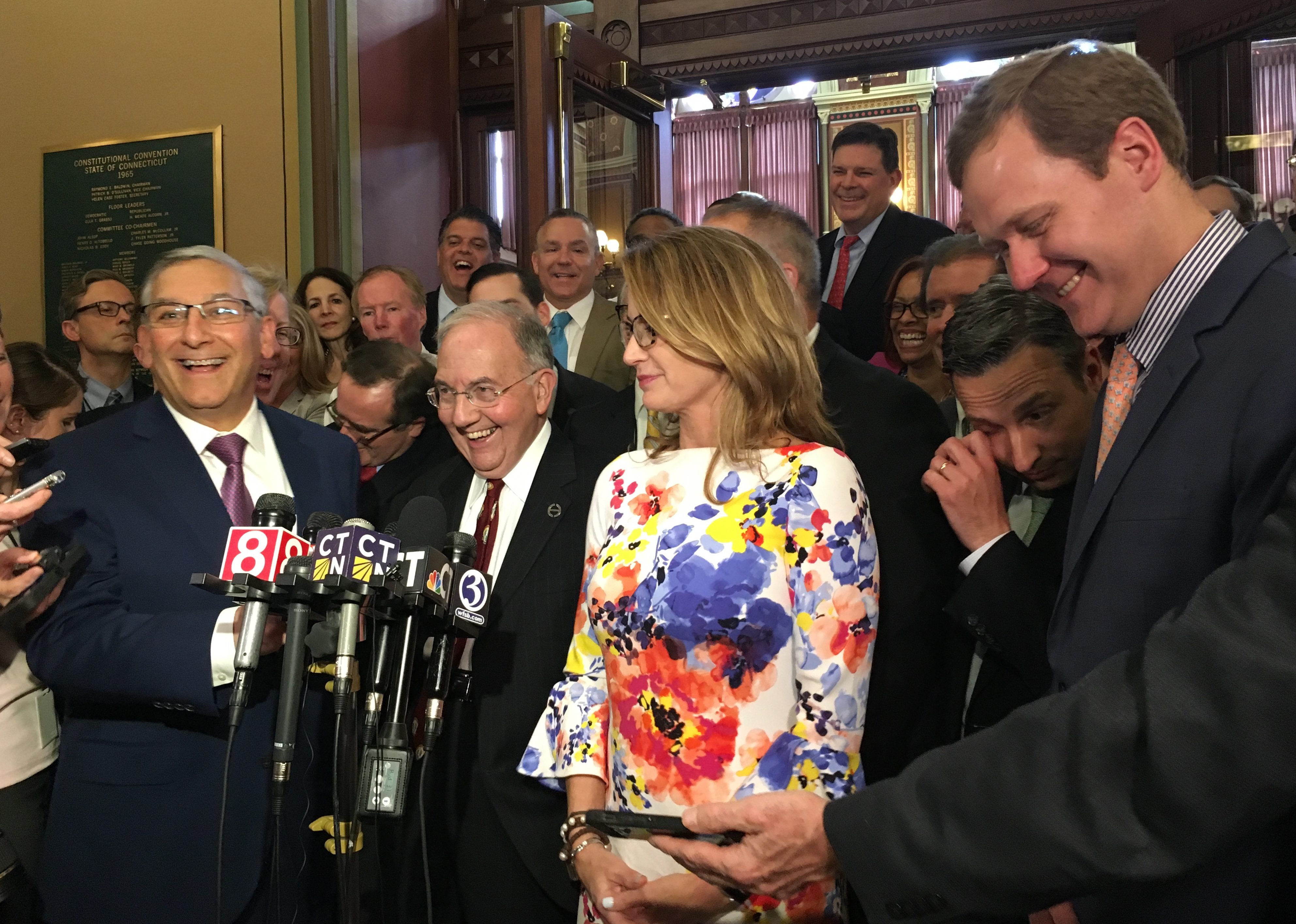
With less than eight hours left in the session, Democratic and Republican legislative leaders announced a deal Wednesday to adjust the next state budget, restoring funds for health care and municipal aid — and dropping a series of proposed collective bargaining changes.

Posted inPolitics
Eunice S. Groark dies at 80, lieutenant governor to Weicker
Eunice S. Groark, the first woman in Connecticut to become lieutenant governor, bolting the Republican Party in 1990 with Lowell P. Weicker Jr. to win election as members of the breakaway A Connecticut Party, died Tuesday at the Duncaster retirement community in Bloomfield. She was 80.

Posted inEnergy & Environment
After near derailment, energy bill heads to governor as fence-mending begins

Updated at 6:25 p.m.
After a near-death experience, energy legislation that will fundamentally change how renewable energy is valued financially in Connecticut passed the state House early Wednesday morning and is now headed to the governor for his expected signature. The legislature also completed action on an environmental bill.

Posted inCT Viewpoints
Let’s teach our children about global warming
According to a new national study, Americans overwhelmingly support teaching our children about global warming – in all 50 states, including Connecticut – and including Republican and Democratic strongholds. Despite this strong public support for climate education, however, there have been recent debates in several state legislatures about whether to include climate change in K-12 science education.
Posted inCT Viewpoints
Connecticut should invest more in community colleges, not less
Connecticut faces an ongoing budget crisis and somehow the community colleges have become the scapegoat. Why is the sector of public higher education that serves the highest number of minority students, the most economically disadvantaged and has a majority female student population under attack?

Posted inCT Viewpoints
Study of religions in high school would build understanding and diversity
Upon discovering that three Biblical excerpts were included in my university’s required “Literature Humanities” seminar, I was shocked. After dropping out of my Confraternity of Christian Doctrine education at a young age, my exposure to the Bible had been nonexistent. “Don’t ask, don’t tell” is the liberal social norm that dominates in Connecticut when it comes to religious beliefs. Consistent with that norm, my public high school education avoided Biblical references. Whenever students mentioned the Bible, my teachers uncomfortably shuffled their feet, awkwardly looked to the side, and quickly changed the subject. Consequently, participating in classroom Bible analysis was an enlightening culture shock.
Posted inCT Viewpoints
Connecticut politicians don’t lack for tactics, they lack vision

With the political conventions to select gubernatorial candidates for the November elections coming up in the next few weeks, I would like to offer some observations. Regardless of party, these apply to all candidates. First, we as the general public know the lobbyists and legislators under the gold dome are more interested in their personal benefit and aggrandizement than in improving the lives of 3.5 million Connecticut residents. If they were interested in us, they would have a 401(k) pension instead of the current defined benefit pension, with mileage and years of service included. Most of the news is inside baseball antics that do not change the price of rice (taxes or services either).

Posted inMoney
Collective bargaining, not money, dominates this budget fight
Connecticut’s legislative leaders struggled into the early morning Wednesday in negotiations to resolve what may be the state’s strangest budget fight: It’s not about money.

Posted inHealth
Drug-price transparency bill passes legislature with no dissent

A bill designed to help Connecticut officials peer into the black box of drug pricing won final approval from a unanimous state Senate early Wednesday, and will now go to the governor. Proponents of the measure called it a necessary first step toward curbing expensive prescription drug prices.